Psycho 1960 from ayyyyyyyyyyy1
Tuesday, 16 December 2014

Friday, 12 December 2014
Preliminary Task
Preliminary Task
This preliminary task is a demonstration of continuity editing, it shoes that i can use: Match on action, shot/reverse shot, 180 degree rule, eye-line match.
In the film Jack Fraser was playing a police officer who is interrogating a murderer Daniel L Bridge.
Danny Canary is the murderer, in the play his name is Daniel L Bridge.
James Casal was the camera guy recording the whole action,
and I was the sound guy, making sure the sound is clear, making sure the mic isn't coming in the picture.
While recording our eye line match match was Daniel L Bridge looking at the clock, this was basically a shot of Daniel's eyes then taking a shot of the clock on the wall.
Also, we did the shot reverse, this was when the officer and Daniel were talking to each other.
The next shot we had in our video was the match on action, this was when James took a shot of the officer walking in the corridor, then a shot of him from inside the room walking through the door.
Evaluation
When doing my filming for my preliminary task, we did use each technique accurately. Also, while filming we didn't make any mistakes, the only thing we need to improve on is how fast we work, we should of finished the filming in one day. The most positive element we have done in this film is the match on action shot when jack is walking through the door, i think it was recorded well. The only improvements we need are just to work quicker and much more faster. The best shot we have had while filming the preliminary task was the match on action, we think this was the best because the shot was very accurate and precise. The shot we need to work on is the reverse shot, when Jack and Danny were talking to each other, this is because they kept laughing and we had to keep filming the shot over and over again.
Monday, 8 December 2014
no country for old men
No Country For old Men Sound
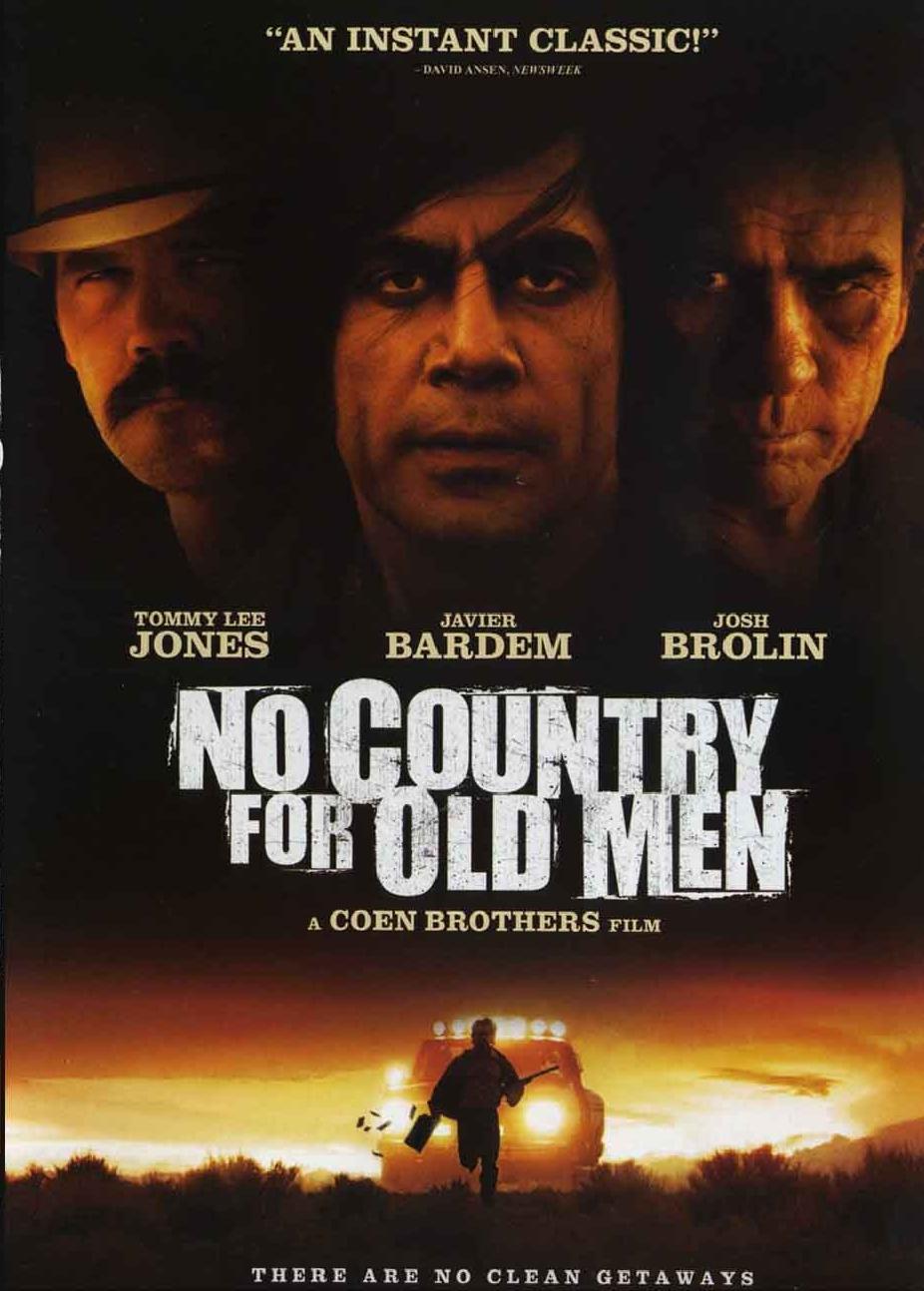 The start of the film starts of with non diegetic sound, its the sound of the narrator speaking and starting off the film by saying what happened. After you can hear the sound of the wind blowing barren wilder niff, it seems deserted, lonely and isolated. furthermore, you then hear the sound of footsteps that's diegetic sound because its happening in the world of the film. Next you can hear the sound of the police car door opening and the person getting inside. Gradually you hear the sound of the car driving off. In addition you then hear the police officer talking on the phone, this is dialog also diegetic sound. As the police officer puts the phone down you hear the sound of the person who got arrested getting up behind the officer and strangling him, you can hear the sound of the hand cuffs around his neck choking the officer also the sound of the officer screaming in pain. After the officer is dead you hear the sound of the killer washing his hands in the sink. the killer then walks out of the station and drives off. Finally the killer stops behind a random person driving his car, you hear dialog between the killer and the person and he puts the oxygen tank pipe to his forehead and he kills the person.
No Country For old Men Camera
The opening scene starts off with a medium angle shot which shows the office putting the person into the police car. The next shot after that is the high angle shot which shows the officer opening the door and sitting the person inside of the car. After its again back to the medium angle shot of the officer putting the oxygen tank into the car. After there's a point of view shot of the officer getting into the car. After that, there's a wide angle shot of the car driving off to the police station. In the police station there's a medium shot followed by the close up shots. After there's a high angle shot of the killer washing the blood off his hands. When the killer is leaving you can see a tracking shot of his footsteps leaving the building and following the car.
No Country For Old Men Editing
The opening scene starts off really slow, nothing really happens then when it gets to the police station things get much faster. throughout the opening scene there are 30/31 cuts.
Mise En Scene
From the opening scene you can tell that its a western setting, the place seems really quiet. It's not really a socializing place, the roads seem empty. The police station seems really empty as-well, only one cop looking after the place.
The start of the film starts of with non diegetic sound, its the sound of the narrator speaking and starting off the film by saying what happened. After you can hear the sound of the wind blowing barren wilder niff, it seems deserted, lonely and isolated. furthermore, you then hear the sound of footsteps that's diegetic sound because its happening in the world of the film. Next you can hear the sound of the police car door opening and the person getting inside. Gradually you hear the sound of the car driving off. In addition you then hear the police officer talking on the phone, this is dialog also diegetic sound. As the police officer puts the phone down you hear the sound of the person who got arrested getting up behind the officer and strangling him, you can hear the sound of the hand cuffs around his neck choking the officer also the sound of the officer screaming in pain. After the officer is dead you hear the sound of the killer washing his hands in the sink. the killer then walks out of the station and drives off. Finally the killer stops behind a random person driving his car, you hear dialog between the killer and the person and he puts the oxygen tank pipe to his forehead and he kills the person.No Country For old Men Camera
The opening scene starts off with a medium angle shot which shows the office putting the person into the police car. The next shot after that is the high angle shot which shows the officer opening the door and sitting the person inside of the car. After its again back to the medium angle shot of the officer putting the oxygen tank into the car. After there's a point of view shot of the officer getting into the car. After that, there's a wide angle shot of the car driving off to the police station. In the police station there's a medium shot followed by the close up shots. After there's a high angle shot of the killer washing the blood off his hands. When the killer is leaving you can see a tracking shot of his footsteps leaving the building and following the car.
No Country For Old Men Editing
The opening scene starts off really slow, nothing really happens then when it gets to the police station things get much faster. throughout the opening scene there are 30/31 cuts.
Mise En Scene
From the opening scene you can tell that its a western setting, the place seems really quiet. It's not really a socializing place, the roads seem empty. The police station seems really empty as-well, only one cop looking after the place.
Friday, 5 December 2014
continuity editing
Continuity editing
Continuity editing is the predominant technique of film editing/video editing. The main purpose for this is to smooth over the inherent discontinuity of the editing process. Furthermore continuity editing requires the director to make the film as much like the audience's reality as possible. For example this would mean the film is trying to recreate what the world around us is trying to make easier on the audience to comprehend and understand the actions happening on screen.
Eyeline match
The eyeline match is when we see a character looking at something off screen and then we cut to a shot of and then we cut to a shot of what they are looking at. The eyeline match is a film editing technique associated with the continuity editing system. Alfred Hitchcock used a lot of eyeline match in his film rear window.
Rear Window Eyeline Match from D.E. Williams on Vimeo.
Match-on-action
The match-on-action is when we see a character start an action in one shot and then we see them continue it in the next. Although the two shots may have actually been shot hours apart from each other, cutting on action gives the impression of continuous time when watching the edited film.
By having a subject begin with an action in one shot and carry it through to completion in the next year, the editor creates a visual bridge which distracts the viewer from noticing the cut or any slight continuity error between the shots.
Graphic match
When two shots are linked with a similar shape or composition of an image. A graphic match often helps establish a strong continuity of action and linking the two shots metaphorically.
180 degree rule
The 180-degree rule is a basic guideline that states that two characters or other elements in the same scene should always have the same left/right hand relationship to each other.An imaginary line called the axis connects the characters and by keeping the camera on one side of this axis for every shot in the scene.

Shot/reverse shot
This is used to show a conversation/argument. This is when one character is shown looking at another character, and then the other character is shown looking back at the first character.
Continuity editing is the predominant technique of film editing/video editing. The main purpose for this is to smooth over the inherent discontinuity of the editing process. Furthermore continuity editing requires the director to make the film as much like the audience's reality as possible. For example this would mean the film is trying to recreate what the world around us is trying to make easier on the audience to comprehend and understand the actions happening on screen.
Eyeline match
The eyeline match is when we see a character looking at something off screen and then we cut to a shot of and then we cut to a shot of what they are looking at. The eyeline match is a film editing technique associated with the continuity editing system. Alfred Hitchcock used a lot of eyeline match in his film rear window.
Rear Window Eyeline Match from D.E. Williams on Vimeo.
Match-on-action
The match-on-action is when we see a character start an action in one shot and then we see them continue it in the next. Although the two shots may have actually been shot hours apart from each other, cutting on action gives the impression of continuous time when watching the edited film.
By having a subject begin with an action in one shot and carry it through to completion in the next year, the editor creates a visual bridge which distracts the viewer from noticing the cut or any slight continuity error between the shots.
Graphic match
When two shots are linked with a similar shape or composition of an image. A graphic match often helps establish a strong continuity of action and linking the two shots metaphorically.
180 degree rule
The 180-degree rule is a basic guideline that states that two characters or other elements in the same scene should always have the same left/right hand relationship to each other.An imaginary line called the axis connects the characters and by keeping the camera on one side of this axis for every shot in the scene.
Shot/reverse shot
This is used to show a conversation/argument. This is when one character is shown looking at another character, and then the other character is shown looking back at the first character.
Monday, 24 November 2014
Media Theory
 Roland Barthes
 Roland Barthes was a French literacy theorist, philosopher, linguist, critic and semiotician. He was born on the 12th of November and died on the 26th of March 1980. He was born in a small town called cherbourg in Normandy.
Roland Barthes discovered the 'enigma codes' that apply to all thrillers.
The enigma code is the mystery in the film, its in every thriller.
Roland Barthes also said that all texts are a 'complex' bundle of meaning.
There are also 'open' endings where at the end of the film the story isn't resolved.
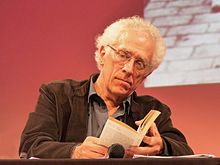 Tzvetan Odorov
 Tzvetan Odorov is a Franco-Bulgarian historian, philosopher, literacy critic, sociologist and an essayist. He was born on the 1st of March 1939. He was born in Sofia Bulgaria.
Tzvetan Odorov discovered the 5 stages, which all films follow, its a narrative pattern through various stages.
1. Equilibrium, at the start of a story, where everything should be as it should, normal.
2. A disruption of that order by an event
3. A recognition of that order by an event
4. An attempt to repair the damage of the disruption
5. A return or restoration of a new equilibrium
Roland Barthes: all texts are 'complex' bundles of meaning.
Enigma codes (problems introduced) usually in 'disruption' stage.
open-not resolved at the end.
polysemic texts-lots of different meanings.
Levi- Traditional Holly wood narrative structure
Vladimir propp
Vladimir Propp - character types - analysed traditional folk stories.
hero/villain/helper/Donor(provider)/farther/dispatcher/princess/false hero - N.B one character can perform more than one role.
Laura Mulvey
 Laura Mulvey is a British feminist film theorist, she was born on the 15th of august 1941. She made a theory called the 'male gaze theory.' This theory suggests that the male gaze denies women human identity, relegating hem to the status of objects to be admired for physical appearance.
The theory suggests women can more often than not only watch a film from a secondary perspective and only view themselves from a mans perspective. However the presence of a women is mainstream film texts is something that is vital. Often a female character has no real importance herself, it is how she makes the male feel or act that is the importance. Mulvey states that the role o a female character in a narrative has two functions.
1. As an erotic object for the characters within the narrative view.
2. As an erotic object for the spectators within the cinema to view.
Laura Mulvey also discussed the term 'scopophilia' which means 'love of watching'
Laura Mulvey's theory relates to classical Hollywood cinema.
The opening scene of a history of violence
 A History Of Violence
Opening Scene Sound
The opening scene starts with diegetic sound of drilling in the back ground that leads up to the sound of the car door opening and the person getting in also as the person get in you can hear dialog from both the characters. After that the sound that you hear the sound of the radio station that is diegetic. While the person drives the car you can hear other cars in the background. When the car stops in-front of the door and the other character gets in you can hear the sound of the car door as he enters the car again after that you can hear dialog. When character gets out the car and walks into the house you can hear the sound of tension build up this is non diegetic sound because only the audience watching the film can hear it, the characters in the film cant. When the persons looking around the house you can hear the sound of the bell and the sound of the tap water pouring into the bottle. As the water is being poured into the bottle a little girl comes near to the man and you can hear more dialog, next the sound of gun shot and the girl's scream is both diegetic.
Opening Scene Camera
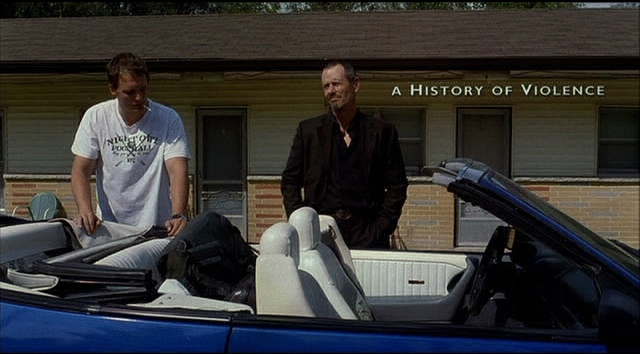 In the opening scene of the film it starts off with two shots, the tracking shot followed by the medium angle shot that shows the two characters. From watching the film you can see that it was filmed by a steady cam. When the cars moving the camera has a tracking shot to follow the car that's followed by the point of view shot. When the person enters the house again the camera has a steady tracking shot, it follows him around the shot. When the girl comes there's a close shot of the gun behind his back. finally the last shot is a low angle shot of the girl screaming.
Opening Scene Mise En Scene
From the opening scene you can see that the the films filmed in a western setting. You can see that the place is a family sort of motel there's garden chairs. The car seems pretty old and the people are dressed pretty casual, casual smart clothes. The motel looks really deserted it seems mysterious like something is about to happen. When the person goes into the house there are two dead bodies on the floor. Followed by the gun that shows danger.
Editing
The opening scene doesn't really contain alot of edits, all together in the opening scene there are about 11/12 cuts most of the cuts happen during dramatic moments. the edits are really slow and that makes the film even more mysterious.
Friday, 21 November 2014
Styles of editing

Transition - how the shots are joined together.
Straight cut
A straight cut shot is when one shot moves instantaneously to the next shot without grasping too much of the audiences attention. Most films nowadays have a straight cut shot, its really common.
The straight cut shot helps retain reality. The positive thing about a straight cut shot is that it doesn't break the viewers suspension of disbelief.
Dissolve

If the film maker wants to show a connection between two characters, places or objects he would use a dissolve shot and blend it all in.
Fades
A fade shot is a gradual darkening or lightening of an image until it becomes black or white. One shot will fade only a black or white screen can be seen.
Also, a fade shot indicates the end of a particular section of time within the narrative. Finally, it can also show the passing of time.
Wipes

A film that uses a lot of wipes is a film called star wars.
Jump cut
A jump cut is where the audiences attention is brought into focus on something very suddenly. It is mainly in which two sequential shots of the same subjects are taken from the same camera position but it varies only slightly. This type of edit gives the effect of jumping forward in time.


Birds

The Birds
The birds is a 1963 horror/thriller film directed by Alfred Hitchcock. the writers of the film were Daphne Du Maurier who wrote the story and Evan Hunter who wrote the screen play. The stars of the film were Rob Taylor, Tippi Hendren and Suzanne Plushette. The film is 119 minutes long.
Thriller Conventions
The external threat in the film is from nature, 'The Birds'. Usually in Hitchcock films there's 'nowhere to hide' for example in birds they were in

Furthermore, there's a lot of suspense used in the film, for example when Melanie is going into the school she notices all the birds outside and she goes
into the school and tells everyone to run out.
In addition, dramatic irony is also used in the film, for example in the school yard scene Tippi Hendren does not know the birds have been gathering but the audience does, the audience has knowledge denied to the character. Hitchcock Technique (sound) in the schoolyard scene the underlying score of the innocent child's song is in contrast to the evil in the nature. Tippi Henderson's character is only guilty of taking nature for granted. In the birds the MacGuffin is the 'love birds' because because of the birds the story kept going, the audience don't really care about the birds they want to see the actor and actress get together.
Did you know?
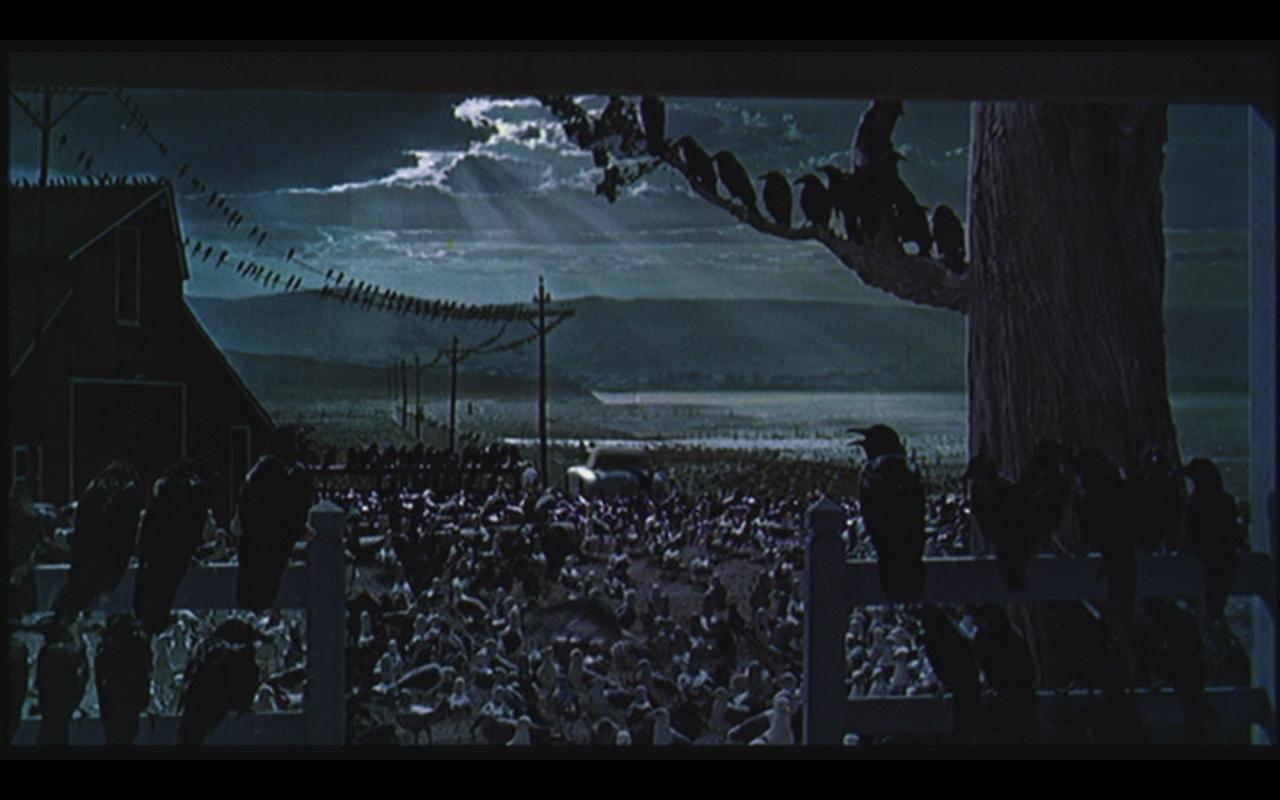 The scene where Tippi Hendren is ravaged by birds near the end of the movie took a week to film, the birds were attached to her clothes by long nylon threads so they could not get away. It is believed that Hitchcock had a crush on Tippi and she rejected him so he just told her to go upstairs and open the door, she didn't know that she was going to be ambushed by the birds. it is said to believe that Tippi suffered a lot from that, she was in therapy for years. Also, the film features 370 effects shots. The final shot is composite of 32 separately filmed elements. In conclusion, a number of endings were being
considered for this film. One that was considered
would have showed the Golden Gate Bridge
completely covered by birds.
However the film didn't finish with the usual 'THE END'
title because Hitchcock wanted to give the impression of
unending terror.
When audience left the film's UK premier at the Odeon, Leicester Square, London, they were greeted by the sound of screeching and flapping birds by loudspeakers hidden in the trees to scare them further.
unknown
 Unknown (2011)
Unknown is a 2011 thriller, it was directed by Jaume Collet-Serra and the writers of the film were Oliver Butcher who wrote the screenplay and Stephen Cornwell who also wrote the screenplay.
The stars of the film are Liam Neeson, Diane Kruger and January Jones.
The budget of the film was $30,000,000 (estimated). In the opening weekend the film made $21,856,389. Gradually by when the film had gone worldwide it made $130,786,397.
Key Scenes of tension
The film has a lot of essential characteristic of a good thriller, in the film there are alot of moments of high tension. For example the hospital scene where Liam Neeson is reaching for scissors leading to murder. The scene has effective sound that, disorienting sounds. The shot most used in the hospital scene is the close up, this was used efficiently. lastly, in the scene there was fast editing that lead to the escape.
Another scene that was efficient was the club scene, this scene was
good because it had loud booming soundtrack that was disorientating and
threatening. Also the dark screen, you could only see shadows, it looked indistinct
it would make the viewer share the main character's confusion.
Featurette behind the scenes
From the featurette behind the scenes all the stars call the film a psychological thriller, its nail baiting it makes you wonder what is happening. The stars also say the amnesia and the identity cris is the villain in the film.
The MacGuffin
The MacGuffin in this film is Prince Shalla world food, because of this the basics of the story is provided but really and truly the viewer is only interested in Liam Neeson's character.
 The Car Chase
This scene has a lot of shots used to film it, for example, the close up shot is used regularly when Liam Neeson is in the car. Furthermore, another shot that is used is the tracking shot, it follows the car while being chased. It is effective because it is fast facing it makes the viewer really want to know what happens. The lighting in the scene is dark, its filmed at night.
rope
Rope
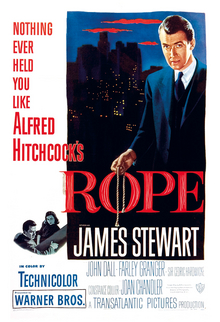
The Trailer
The trailer is really effective because it grabs the viewers attention, the music causes a lot of suspense, it makes the viewers actually want to watch the film.Even though the trailer ruins the best bits of the film, it shows who killed him, it ruins the whole film.
The opening scene
The opening scene is one of the most best scenes of the film, this is because the opening scene has the most suspense, it makes the audience wonder why the two men have killed the person, what will happen next, if they'd ever get caught. The scene starts off by grabbing the readers attention already from the start.
Background context
Rope is adapted from patrick hamilton's 1929 play which itself was said to be based on the grisly Leopold and Loeb case of 1924. Nathan Leopold and Richard Leob upper-class chicago law students who murdered a teenage boy.
Suspense
Devices such as suspense, red herrings and cliffhangers are used extensively, for an example ascene where suspense is used is the casket, when Rupert is going to open the casket to see whether the dead body is in there or not.
10 minute exract
When Alfred Hitchcock was filming this film he wanted to film it like it was a play, therefore he had to film very quickly, and if he wanted to change the reel he would have to focus the camera on one thing and do it quickly. This wasn't really good because everything was cramped in it didn't really look that good. The whole play was shot in continuous, unedited 10-minute takes.
The Trailer
The trailer is really effective because it grabs the viewers attention, the music causes a lot of suspense, it makes the viewers actually want to watch the film.Even though the trailer ruins the best bits of the film, it shows who killed him, it ruins the whole film.
The opening scene
The opening scene is one of the most best scenes of the film, this is because the opening scene has the most suspense, it makes the audience wonder why the two men have killed the person, what will happen next, if they'd ever get caught. The scene starts off by grabbing the readers attention already from the start.
Background context
Rope is adapted from patrick hamilton's 1929 play which itself was said to be based on the grisly Leopold and Loeb case of 1924. Nathan Leopold and Richard Leob upper-class chicago law students who murdered a teenage boy.
Suspense
Devices such as suspense, red herrings and cliffhangers are used extensively, for an example ascene where suspense is used is the casket, when Rupert is going to open the casket to see whether the dead body is in there or not.
10 minute exract
When Alfred Hitchcock was filming this film he wanted to film it like it was a play, therefore he had to film very quickly, and if he wanted to change the reel he would have to focus the camera on one thing and do it quickly. This wasn't really good because everything was cramped in it didn't really look that good. The whole play was shot in continuous, unedited 10-minute takes.
North By North West A Perfect Thriller
North by North by West is an an American spy thriller film made in 1959. It was filmed in the Unites States and directed by Alfred Hitchcock. The main actor of the film is Cary Grand and the actress is Eva Marie Saint. The role of the villain was played by James Mason. The screen play was written by Ernest Lehman who wanted to write 'the Hitchcock picture to end all the Hitchcock pictures'.
Plot
North by North West is about a story of how a person called Roger O. Thornhill is mistaken for 'George Kaplan' and is kidnapped by Valerian and Licht two hit men who work for Vandamm, the villain of the movie. The two hit men take Thornhill to a long island estate of Lester Townsend. When he arrives Vandamm interrogates Thornhill. Leonard then intends to get rid of Thornhill by forcing him to drink bourbon. However because Thornhill is a resource and smart hero, he manages to escape the staged driving. Throughout the film Roger tries to escape the villains.

North by North West follows Todorov's narrative theory, it contains five stages,
1. Equilibrium, where everything is as it should be.
2. A disruption of that order by an event.
3. A recognition that disorder by an event.
4.An attempt to repair the damage of the disrupt.
5.A return or restoration of a new equilibrium.
itchcock
 In all of Hitchcock's films, Hitchcock planned every scene visually in advance, when directing Hitchcock never looked at the camera, he imagined himself looking at a cinema screen. He's films contain alot of fast pacing and frequent action, In North by North West Hitchcock make the actor of the film a resourceful hero, for example the scene where he's in the exhibition and the villains try to kill him, he gets away. Hitchcock believes that the stress on the visuals makes cinema accessible in different languages. Hitchcock also said he wants to transfer the menace that appears on screen into the mind of the audience.
The most greatest scene from North by North West
In this scene Roger O. Thornhill who is getting mistaken for George Kaplan finally comes to meet George Kaplan, and is nearly killed by a crop duster. As you can see the crop duster is chasing Roger, the suspence in this scene was overwhelming
Representation of women in 'North by Northwest'
Laura Mulvey came up with 'visual pleasure and cinema' she said that men are active and women are passive. Women do not have agency, they don'd move the plot forward.The camera is male, the audience is forced to identify with male gaze. The cinema reflects patriarchal society. Patriarchy & phallocentrism linked - phallus (penis) a symbol of power - e.g. in cinema guns =phallus=power.
Patriarchal society= Men dictate the rules.
Mulvey argues we live in a patriarchal society in which men set the majority of the rules and construct and represent the ideal visions, roles and male dominance over women.
The worry is a passive audience will be influenced by this representation of reality and copy it and it will actually become reality.
She believed in the 'male gaze' which was women were viewed as objects of male erotic desire in film and audience.
That men were active and women were passive.
The women in north by north west is scene as an object for sexual pleasure.
Friday, 24 October 2014
sound exercise
Sound exercise evaluation
firstly, the first shot i had for my sound exercise was the pan shot, we chose this shot because it follows the character making things look suspicious. Next we master shot to get the view of both the people talking to each other, the sound coming from their mouths is diegetic this is because the sound is coming from the world of the film. We next did the over the shoulder shot because we caught the perspective of both the characters talking. The shot after that was the mid shot followed by the pan shot, we did this to make the audience feel like they want to know whats going on, tension thriller. The next scene has the pan shot followed by non diegetic sound, because the character cannot hear the soundtrack being played in the background. The scene after that has a simple pan shot to follow the character, this also creates tension.
firstly, the first shot i had for my sound exercise was the pan shot, we chose this shot because it follows the character making things look suspicious. Next we master shot to get the view of both the people talking to each other, the sound coming from their mouths is diegetic this is because the sound is coming from the world of the film. We next did the over the shoulder shot because we caught the perspective of both the characters talking. The shot after that was the mid shot followed by the pan shot, we did this to make the audience feel like they want to know whats going on, tension thriller. The next scene has the pan shot followed by non diegetic sound, because the character cannot hear the soundtrack being played in the background. The scene after that has a simple pan shot to follow the character, this also creates tension.
Friday, 19 September 2014
Genre
What is a genre?
A genre is a type or style of film. For example, horror, thriller, romance, mystery, action, etc etc. Genres catogorise films into different sections.


can you guess what genre this is?
what is a narrative?
A narrative is the way a film is set out. You could also call it a spoken or written accounts of events.
www.youtube.com/watch?v=-psayRM1XqU
A genre is a type or style of film. For example, horror, thriller, romance, mystery, action, etc etc. Genres catogorise films into different sections.
can you guess what genre this is?
what is a narrative?
A narrative is the way a film is set out. You could also call it a spoken or written accounts of events.
www.youtube.com/watch?v=-psayRM1XqU
Tuesday, 16 September 2014
thriller conventions
First of all a thriller is a genre board, it can be a play, a book or a movie that has an exciting plot. generally thrillers have a lot of crime and murder, also thrillers have a fast pacing, so for example one thing happens after another. throughout a thriller film, has lots of frequent action happening. furthermore, thrillers contain a resourceful hero who is usually make, and the villain who presents obstacles the hero must overcome. A standard plot elements of a thriller consists of danger and violence. Thrillers can be defined by the primary mood they create.
Thrillers have a lot of devices which makes them, for example a device they use is suspense which grabs the audiences attention, making them excited, scared, etc etc.
Another device thrillers have are red herrings, which is basically when the audience is tricked along with the actor/actress. In addition thrillers also have cliff hangers, where the audience is literally at the edge of their seats.
 an example of a cliff hanger scene is
https://www.youtube.com/watch?v=897R5qNVYlU
Thrillers often take place in exotic settings, an example of exotic settings would be a foreign country, thrillers are not really filmed at local areas.
Compared to mystery stories thrillers occur on a much grander scale, for example the crimes that must be prevented are serial or mass murder.
In conclusion there are all different kinds of thrillers, i.e, legal thrillers, spy thrillers, action thrillers, adventure thrillers, horror thrillers the list just goes on and on.

Friday, 12 September 2014
Welcome Post
About me
My name is Ayush Bhatt, I am 16 years old. I Study at Robert Clack School 6th form. In school i study advance maths, double business ICT and media. I am going to be writing a blog about thrillers. My favourite genre of films is Horror, my favourite film from that genre is 'The Counjuring'. Apart from films, i also enjoy watching TV series, for example a series on Netflix called 'breaking bad.'


My name is Ayush Bhatt, I am 16 years old. I Study at Robert Clack School 6th form. In school i study advance maths, double business ICT and media. I am going to be writing a blog about thrillers. My favourite genre of films is Horror, my favourite film from that genre is 'The Counjuring'. Apart from films, i also enjoy watching TV series, for example a series on Netflix called 'breaking bad.'
The Brief
You have been asked to produce the titles and opening sequence of a new fiction film in the thriller genre
The sequence should last a maximum of two minutes.
You may work in a group of 2 - 4 students.
As acting is not assessed you are free to use actors that are not members of your group.
The film is worth 60% of your coursework grade.
The accompanying blog is worth 40% of your coursework grade
Together the Foundation Portfolio is worth 50% of the overall AS Level.
Subscribe to:
Posts (Atom)